Artificial intelligence and automation are changing how businesses approach everyday work. Tasks that once required employees to spend hours searching through information, preparing documents, responding to routine requests, analyzing data, or moving information between systems can increasingly be supported by digital technologies.
This does not mean that every task should be automated or that technology will simply replace existing roles. In many organizations, the more practical opportunity is to combine AI and automation with human expertise. Technology can handle repetitive or information-intensive activities while employees focus more of their time on judgment, creativity, relationships, problem-solving, and other activities that require human involvement.
The result is a gradual shift in how work is organized rather than a single technology-driven change.
From Automation to Intelligent Workflows
Traditional automation generally follows predefined rules. If a particular event occurs, the system performs a specific action.
For example, a business may automatically send an email after a customer completes a form, transfer information from one system to another, or generate a standard report at the end of a reporting period.
AI introduces additional possibilities because systems can work with information that is less structured and support tasks that previously required more human involvement.
An organization might use AI to summarize a long document, classify customer requests, analyze large amounts of information, assist with content creation, or help employees find relevant information. When these capabilities are combined with automation, organizations can create workflows in which information is analyzed and then routed to the appropriate process or employee.
This can make automation more flexible and useful across a wider range of business activities.
Reducing Repetitive Work
One of the most practical applications of automation is reducing repetitive work.
Employees in many departments spend considerable time performing activities that are necessary but do not necessarily require their full expertise. Entering information, organizing documents, preparing routine communications, scheduling tasks, and processing standard requests are examples of activities that can sometimes be automated.
Reducing this workload can allow employees to spend more time on activities that require deeper attention.
The objective should not simply be to eliminate tasks. Businesses can also consider whether automation can improve the quality and consistency of those processes while allowing employees to concentrate on work where their contribution creates greater value.
AI as an Employee Assistant
AI can increasingly function as an assistant rather than an independent decision-maker.
An employee might use AI to summarize information before a meeting, organize research, draft an initial document, analyze a dataset, generate ideas, or help locate information across large collections of business material.
The employee remains responsible for reviewing the output and determining how it should be used.
This approach can be particularly useful because it combines the speed and information-processing capabilities of AI with human knowledge and judgment.
Over time, businesses may develop many different forms of AI assistance across departments, with employees using AI according to their specific responsibilities.
Changing Customer Service
Customer service is another area where AI and automation can influence the workplace.
Businesses can use automated systems to handle common requests, route inquiries, provide information, and support service teams. AI can also assist employees by summarizing previous interactions or helping them find relevant information more quickly.
This can allow customer service teams to spend more time on complex situations that require empathy, negotiation, problem-solving, or deeper knowledge.
However, businesses need to design these systems carefully. Customers may become frustrated if automated processes make it difficult to reach a person when human assistance is genuinely required.
The objective should therefore be to use automation where it improves the experience while maintaining appropriate human involvement.
Supporting Better Decisions
AI can also help employees process information more efficiently.
Modern businesses generate information across sales, finance, operations, customer service, marketing, and other departments. Employees may struggle to review all of this information manually.
AI and analytics technologies can help identify patterns, summarize information, highlight potential issues, and support analysis.
This does not mean that AI should make every business decision.
In many situations, the technology can provide information or recommendations while the employee or management team makes the final decision. This approach allows organizations to benefit from faster analysis without removing human accountability.
The Importance of Human Skills
As technology takes on more repetitive and information-processing tasks, human capabilities can become even more important.
Communication, critical thinking, creativity, leadership, relationship building, negotiation, empathy, and contextual judgment are difficult to reduce to simple automated processes.
This means the future workplace is not only about developing technical capabilities. Businesses also need to consider how employees can strengthen the skills that complement technology.
An employee who understands both their professional field and how to work effectively with AI may be able to accomplish more than an employee who relies entirely on either technology or traditional methods.
Employees Need Time to Adapt
Introducing AI and automation can change established ways of working.
Employees may need to learn new applications, understand new workflows, review AI-generated information, or take responsibility for processes that have been redesigned.
This transition requires communication and training.
Employees are more likely to adopt new technologies when they understand why the technology is being introduced, how it will affect their work, and what is expected from them.
Businesses should therefore treat workforce preparation as part of technology implementation rather than as an activity that happens afterward.
Accuracy and Human Oversight
AI-generated information can be useful, but it still requires appropriate review.
AI systems can produce incorrect information, misunderstand context, or generate results that appear convincing without being accurate. The level of human oversight required will depend on the task and the potential consequences of an incorrect result.
For routine and low-risk applications, limited review may be appropriate. For decisions involving sensitive information, customers, finances, security, compliance, or significant business consequences, stronger human oversight may be necessary.
Businesses should establish clear expectations around when employees should verify AI-generated results and when human approval is required.
Preparing for AI-Enabled Workflows
Organizations do not need to transform their entire workforce at once.
A practical approach can begin with specific processes where employees already experience repetitive work, information overload, slow processing, or unnecessary administrative effort.
Businesses can examine the existing process, identify where AI or automation could help, test the technology, measure the results, and make adjustments before expanding it to other areas.
This gradual approach can provide employees with opportunities to learn while giving management a clearer understanding of the technology’s actual business value.
Building Responsible AI Practices
As AI becomes more common in the workplace, businesses also need appropriate policies around its use.
Employees should understand which tools are approved for business use, what information can be entered into AI systems, how sensitive data should be handled, and when AI-generated information needs to be reviewed.
Organizations may also need to consider privacy, cybersecurity, intellectual property, access controls, and regulatory requirements depending on how AI is being used.
Clear policies can provide employees with practical guidance while helping organizations manage the risks associated with increasingly widespread AI adoption.
The Workplace Is Becoming More Collaborative
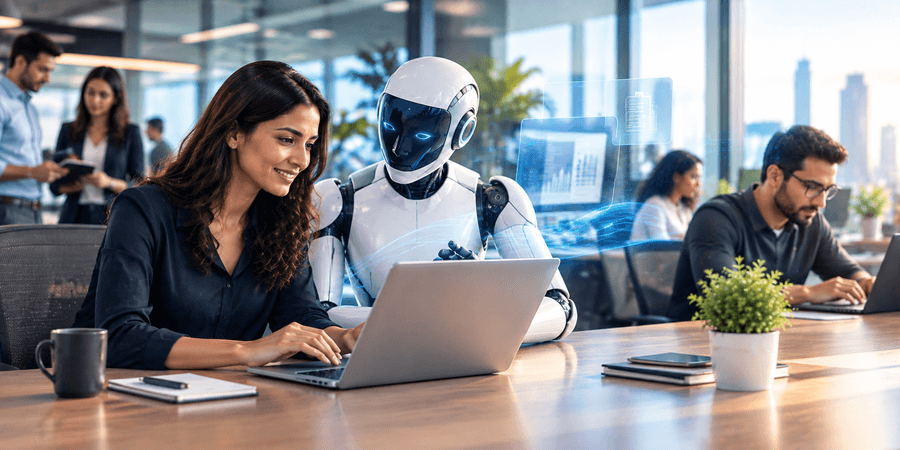
The future workplace is likely to involve closer collaboration between people and technology.
Instead of thinking of AI as a separate system that operates outside normal work, businesses can integrate AI capabilities into applications and workflows that employees already use.
An employee may receive AI-generated suggestions within a business application, use automated workflows to move information between systems, or rely on an AI assistant to summarize information before making a decision.
This creates a workplace where technology becomes increasingly embedded in everyday activities.
Measuring the Impact
Businesses should also measure whether AI and automation are actually improving work.
Productivity is one possible measure, but it is not the only one. Organizations can also examine processing time, error rates, employee workload, customer experience, response times, operating costs, and other outcomes relevant to the specific process.
Measurement helps businesses distinguish between technology adoption and genuine improvement.
If an automated process saves time but creates additional errors or customer problems, the organization may need to redesign it. Similarly, if an AI assistant reduces administrative work while improving employee productivity, the business may have a strong case for expanding its use.
Conclusion
AI and automation are changing the modern workplace by helping businesses process information, automate repetitive activities, support employees, and redesign workflows.
The most effective approach is unlikely to be simply replacing human work with technology. Instead, businesses can focus on identifying where AI and automation complement human capabilities and create meaningful improvements.
Employees will continue to bring judgment, creativity, experience, communication, and context to the workplace, while technology can increasingly assist with information processing and repetitive tasks.
The businesses that adapt effectively will be those that view AI and automation not only as technology investments, but as opportunities to rethink how work is performed, how employees contribute, and how technology and people can work together more effectively.