Technology has traditionally been viewed as a function that supports the business.
IT teams maintained infrastructure, implemented software, managed networks, protected systems, and kept employees connected. Business teams, meanwhile, focused on customers, operations, revenue, and growth.
That separation is becoming increasingly difficult to maintain.
Today, technology influences how businesses communicate with customers, develop products, analyze information, manage operations, protect data, and compete in changing markets. Decisions about technology can therefore have a direct impact on business performance.
This is why technology strategy is increasingly becoming part of business strategy.
The question is no longer simply which technology a company should purchase. It is how technology can support what the business is trying to achieve.
Technology Is Now Part of the Business Model
For many organizations, technology is no longer operating quietly in the background.
A retailer may depend on digital commerce platforms and customer analytics. A financial organization may rely on digital banking infrastructure and cybersecurity. A manufacturer may use connected systems, automation, and real-time data across its operations.
Even businesses that do not consider themselves technology companies can depend heavily on technology to deliver their products and services.
This changes the role of technology leadership.
Technology decisions can influence:
- How efficiently employees work
- How quickly customers receive services
- How information moves across an organization
- How products and services are delivered
- How securely business data is managed
- How quickly a company can respond to change
- How effectively management can use information to make decisions
As a result, technology planning increasingly needs to be connected to broader business priorities.
Start With Business Objectives
A common mistake in technology planning is beginning with a technology rather than a business problem.
A company may see a new AI platform, cloud service, analytics system, or automation tool and immediately consider how it could be implemented.
A stronger approach is to begin with the organization’s objectives.
For example:
If the goal is operational efficiency, the business might examine automation, workflow management, process integration, or data systems.
If the goal is better customer experience, technology decisions might focus on digital channels, customer data, personalization, service platforms, or communication systems.
If the goal is expansion, technology strategy may need to consider scalability, cloud infrastructure, cybersecurity, data availability, and integration.
If the goal is better decision-making, analytics, data management, reporting, and AI capabilities may become priorities.
This approach ensures that technology investment has a clear connection to business needs.
Building the Right Technology Foundation
A business cannot always introduce new technology independently of its existing environment.
Applications, databases, infrastructure, security systems, communication platforms, and workflows often need to work together.
This makes the underlying technology foundation important.
Organizations should understand their existing environment before introducing major new systems.
Important considerations can include:
- Existing applications and infrastructure
- Data architecture
- System integration
- Security requirements
- Scalability
- Reliability
- Employee needs
- Maintenance requirements
- Future technology requirements
A strong foundation can make it easier to introduce new capabilities without creating unnecessary complexity.
The Importance of Integration
One of the biggest challenges businesses face is technology fragmentation.
Different departments may use different applications, databases, communication platforms, and workflows. Over time, this can create disconnected systems and duplicated information.
Employees may have to move information manually between applications. Management may struggle to obtain a consistent view of business performance.
Technology strategy should therefore consider how systems work together, not simply what individual systems can do.
Integration can help organizations create smoother workflows, improve information flow, and reduce unnecessary duplication.
This becomes particularly important as businesses introduce AI and automation.
An AI system may provide limited value if it cannot access the information or workflows necessary to perform its intended function.
Cloud and Scalable Infrastructure
Business requirements can change quickly.
A company may expand into new markets, launch new digital services, increase its workforce, or experience changes in customer demand.
Technology infrastructure therefore needs to support both current requirements and future possibilities.
Cloud technologies can provide organizations with flexible infrastructure and access to computing, storage, applications, data services, and other capabilities.
However, adopting cloud technology should not be treated as an objective by itself.
Businesses still need to consider:
- Which workloads should move to the cloud
- Security and compliance requirements
- Data management
- Integration with existing systems
- Cost management
- Performance
- Business continuity
The right technology strategy depends on the organization’s specific requirements rather than simply following a technology trend.
Security Must Be Part of Strategy
As technology becomes more central to business operations, security cannot be treated as a separate consideration added at the end of a technology project.
A new application, cloud environment, connected device, or data platform can introduce new security requirements.
Technology planning should therefore consider security from the beginning.
This can include identity and access management, data protection, network security, monitoring, incident response, and appropriate governance.
Security is particularly important when organizations connect more systems and make more business processes digital.
The objective is not simply to protect individual systems. It is to build an environment where the organization can use technology while managing the associated risks.
Technology and Employee Productivity
Technology strategy also has a direct connection with how employees work.
Introducing another application does not automatically improve productivity.
If employees have to work across too many disconnected systems, productivity can actually become more difficult.
Businesses should therefore consider the employee experience when evaluating technology.
Questions worth asking include:
- Does the technology simplify an existing process?
- Does it reduce repetitive work?
- Is information easier to access?
- Can employees learn to use it effectively?
- Does it integrate with existing tools?
- Does it create additional administrative work?
Technology should ideally make important business processes clearer and more efficient rather than simply adding another layer of complexity.
Making Better Technology Investments
Technology investment decisions can involve significant financial and organizational commitments.
Businesses therefore need a structured way to evaluate potential investments.
Cost is obviously important, but it is only one part of the decision.
Organizations can also consider:
- Expected business value
- Implementation requirements
- Integration
- Scalability
- Security
- Employee adoption
- Vendor capabilities
- Ongoing support
- Long-term flexibility
A technology solution that appears inexpensive initially may require significant integration or maintenance later.
Similarly, a more sophisticated solution may provide greater value if it addresses a critical business requirement and can scale with the organization.
The Role of Leadership
Technology strategy increasingly requires collaboration between business and technology leaders.
Business leaders understand organizational priorities, customers, markets, and operational challenges. Technology leaders understand systems, infrastructure, data, security, and emerging capabilities.
Bringing these perspectives together can help organizations make more informed technology decisions.
Instead of asking:
“What technology should we implement?”
leadership teams can ask:
“What business problem are we trying to solve, and what technology capabilities can help us solve it?”
That change in perspective can significantly influence technology planning.
Preparing for Continuous Change
Technology strategy cannot be a one-time exercise.
Technology continues to evolve, and business requirements change with it.
Artificial intelligence, automation, cloud computing, data platforms, cybersecurity technologies, and other capabilities will continue to develop.
Organizations therefore need strategies that can adapt.
This does not mean adopting every new technology as soon as it appears. It means maintaining enough flexibility to evaluate new capabilities and determine whether they have meaningful relevance to the business.
A technology strategy should provide direction without preventing the organization from adapting.
Conclusion
Technology is increasingly intertwined with how businesses operate, compete, serve customers, and make decisions.
That makes technology strategy more than an IT planning exercise.
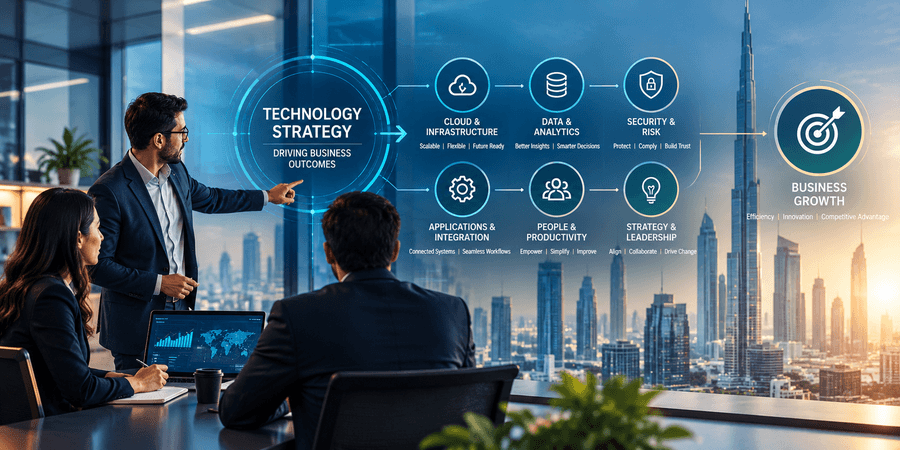
A strong technology strategy connects business objectives with infrastructure, applications, data, security, people, and future capabilities. It helps organizations determine where technology can create value while avoiding unnecessary complexity and disconnected investments.
For business leaders, the central question is becoming clearer:
Technology should not simply support the business. It should be planned around what the business needs to achieve.
When technology decisions and business objectives move in the same direction, organizations can create a stronger foundation for efficiency, innovation, adaptability, and long-term growth.